Websites and web apps for startups
Two jobs, one team: a website that explains your product to customers and investors, and the web app your users sign in to. We build both so they look and work as one.
A startup on the web usually needs two things. The first is a site that says clearly what the product does, loads fast and brings in sign-ups. The second is the web app itself, where users do the work the product exists for. Built by different people, the two drift apart in look, tone and data. We plan and build them together: the marketing pages, the sign-up path and the application behind it, on one design system, so the step from visitor to user feels like a single product.
Scope your site or web appWhat you get
A site that explains the product
Pages that say what you do, for whom and what to do next, written and laid out for the people you want to reach.
A web app users can sign in to
The product itself in the browser, with accounts, the core workflow and the data behind it.
One design system for both
Shared components and styles, so the site and the app read as one product and change together.
Search and speed from the start
Pages built to be found by search engines and to load fast on an ordinary phone connection.
A sign-up path you can measure
Analytics on the route from first visit to active user, so you see where people drop off.
How it works
- 01
Separate the two jobs
We agree what the site must say and what the app must do, and where one hands over to the other.
- 02
Design once
We design the site and the app on a shared system, starting with the pages and screens that matter most.
- 03
Build the site and the app
We build both, and the sign-up path between them, with analytics in place from the first day.
- 04
Launch and adjust
We release, watch how visitors and users behave, and change what holds them back.
Related case studies
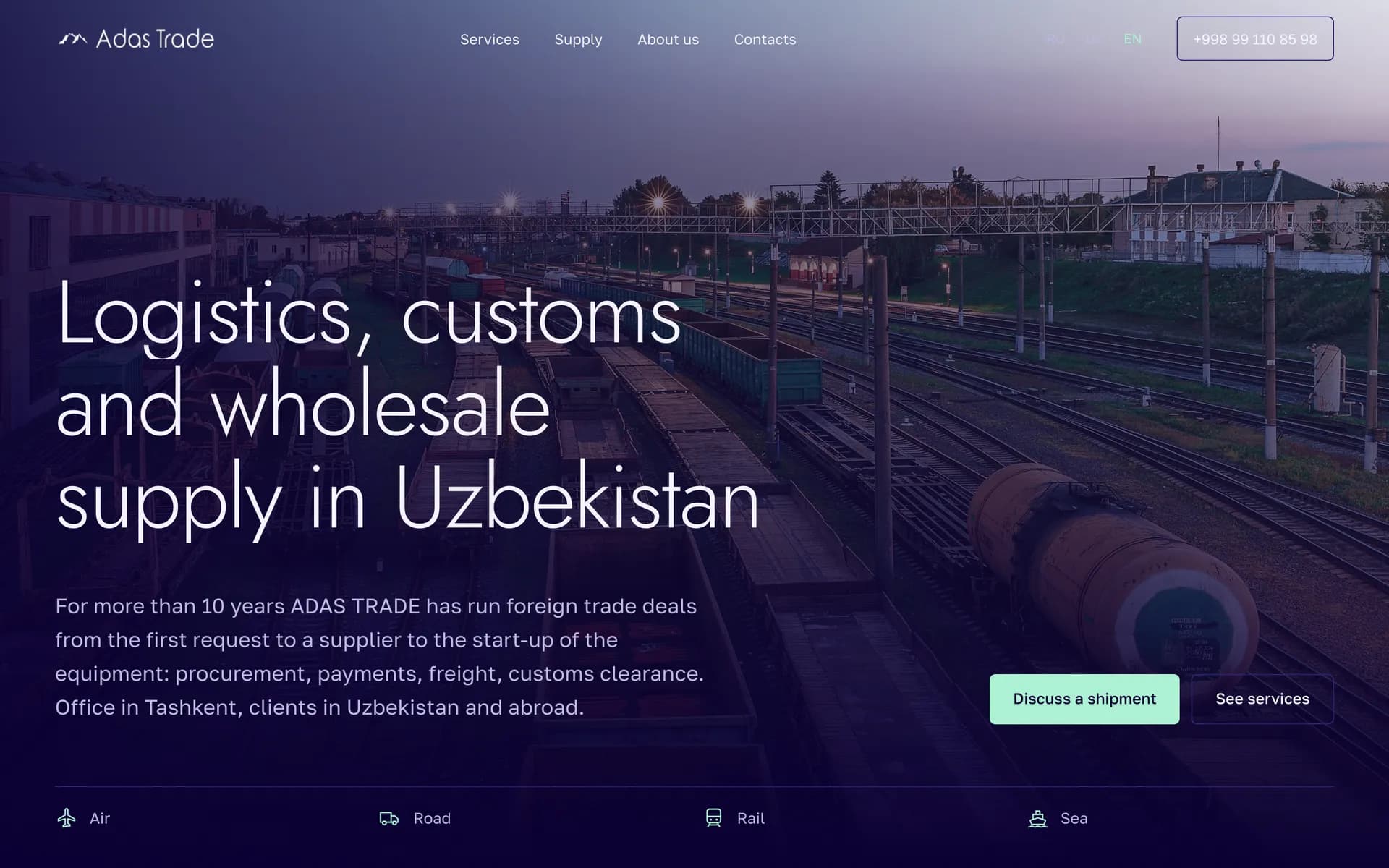
Trade and logistics · B2B
A three-language site for a trade and customs company
Explain seven connected services, from procurement to commissioning, to importers and foreign suppliers in three languages, in a tone that fits a customs business, and make it easy to call or write.
In production at adas-trade.uz, in Russian, Uzbek and English.
Several ways to work with us
Pick the shape that fits. We’ll adjust it as the product grows.
Project
One system, fixed scope
- Fixed scope, fixed deadline
- Led by a senior engineer
- Full code ownership
- Direct communication
Partner
Ongoing engineering capacity
- Dedicated engineering time
- Architecture through production
- Monthly scope reviews
- Priority response
Complex systems
Architecture-first engagements
- Migration and scaling
- AI automation built in
- Senior architecture review
- We own the hard parts
Have questions?
Answers to what we are asked most before a project starts.
What is custom software development?
It is building software around one business and its customers, rather than bending an off-the-shelf product to fit. The work runs from deciding what to build, through design, engineering and testing, to release and the upkeep after it. The result does what your business needs, in the way it works.
What are the common ways to hire developers?
There are three main ones. An in-house team gives the most control, but it takes months to hire and costs the most to keep. Freelancers start quickly, but someone has to lead them and join up their work. A studio brings a complete team of analysts, designers and engineers who already work together, and it grows or shrinks with the project.
How can I start a digital business?
Start with the problem, not the software. Talk to the people you want to serve and check that they would pay for a solution. Test the idea as cheaply as you can: sometimes a landing page with a waiting list is enough. Then build the smallest product that proves the idea, release it, and let what real users do decide what comes next.
What is digital transformation for enterprises?
It is changing how a company works so that software carries more of the load: connected systems in place of manual steps and scattered spreadsheets, old software moved to a modern platform, and decisions made from data. It works best in steps, starting where the gain is largest, with each step released and measured before the next.
What are you building?
Tell us about your project. We’ll get back to you to talk through scope, timeline and first steps.
Want to talk sooner?
Book a quick call